The Table That Hasn't Closed Yet: Understanding Passover, the Last Supper, and Your Invitation to It
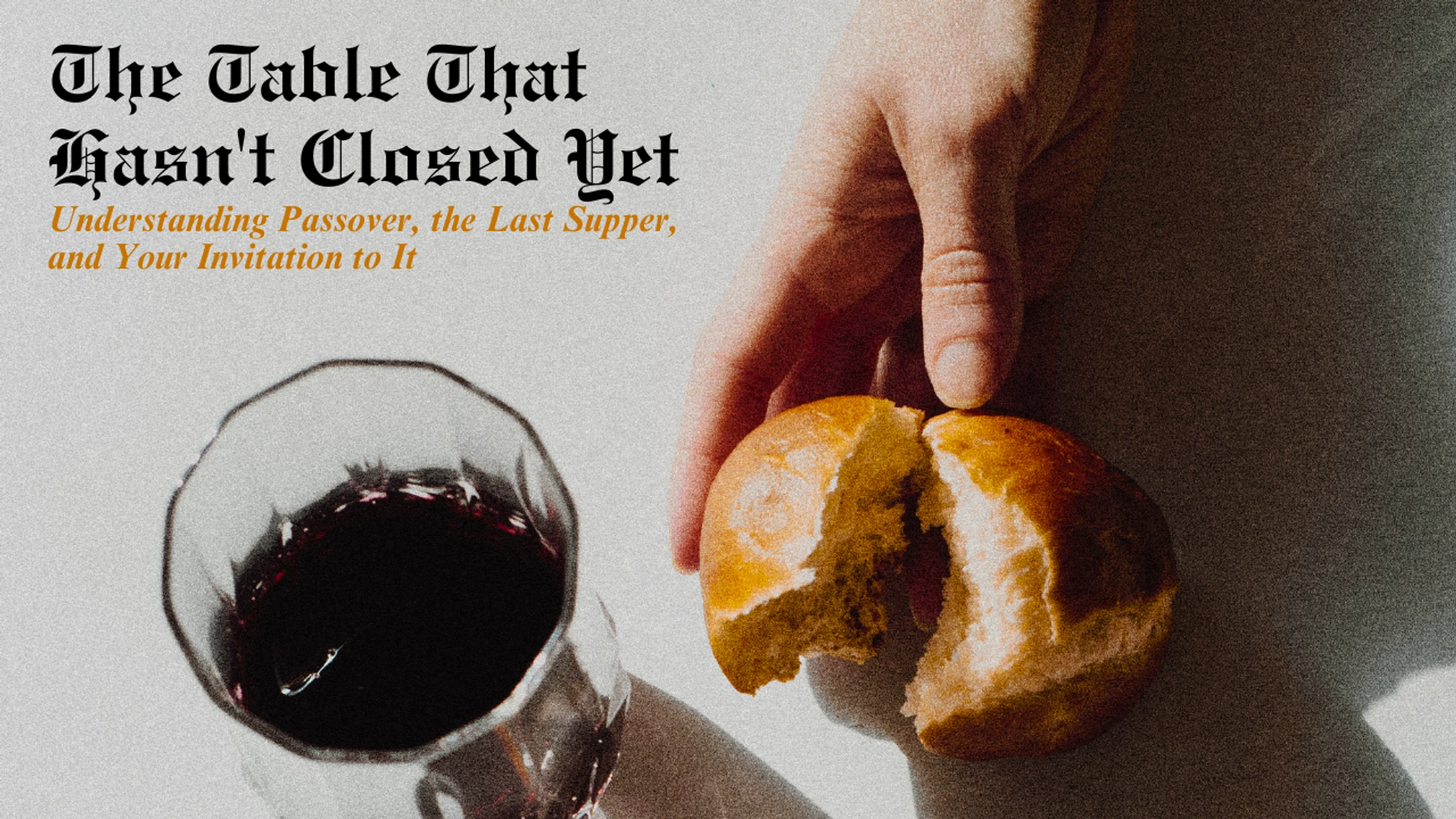
Every family has one meal a year where nobody agreed on the rules, but everybody follows them anyway. You know who says the blessing. You know what goes where on the table. You know the story that gets told the same way, every single year, whether anyone in the room feels like hearing it again or not.
Every family has one meal a year where nobody agreed on the rules, but everybody follows them anyway. You know who says the blessing. You know what goes where on the table. You know the story that gets told the same way, every single year, whether anyone in the room feels like hearing it again or not.
That was Passover for the people of Israel. Same meal, same story, same order, for fourteen hundred years. And on the last night of his life, Jesus sat down to that meal. Nothing about the setup looked unusual. But by the end of it, he was going to hold something back on purpose. And what he didn't do would end up telling us as much as what he did.
If you've ever sat through a communion service and wondered what any of it actually means, or why a Jewish festival from three thousand years ago has anything to do with a Sunday morning in a modern church, this is for you.
What Passover Actually Was
Before we get into what happened at that final meal, it helps to know what Passover was for a first-century Jewish family. This wasn't a quick dinner. It was a multi-hour ritual meal, done the same way every year, where every single element on the table meant something. The herbs. The bread. And especially the wine.
Wine at a sacred meal like this wasn't just a drink. It was a symbol of joy, blessing, and covenant, the ancient word for a binding, unbreakable promise. So when the meal was structured around four separate cups of wine, that wasn't four servings for the sake of tradition. That was four distinct, deliberate promises God had made, remembered one cup at a time.
Those four promises trace back to a single passage in Exodus, where God tells Moses what he's about to do for a nation of slaves: I will bring you out. I will deliver you. I will redeem you. I will take you as my people (Exodus 6:6-7). Over time, the Passover meal came to be structured around four named cups, one for each promise, drunk in a fixed order, every family, every year, for fourteen centuries.
Jesus wasn't inventing something new when he sat down at this table. He was walking through four cups everyone at that table had grown up drinking. Where he paused is the whole story.
Quick reference: the four cups
- Cup of Sanctification (Kiddush) — I will bring you out
- Cup of Deliverance (or Judgment) — I will deliver you
- Cup of Redemption (or Blessing) — I will redeem you
- Cup of Praise (or Restoration/Hallel) — I will take you as my people
These four promises come from Exodus 6:6-7, spoken by God to Moses before the actual Passover night in Exodus 12 ever happens:
"Therefore, say to the Israelites: I am the Lord, and I will bring you out from under the forced labor of the Egyptians. I will rescue you from slavery to them, and I will redeem you with an outstretched arm and great acts of judgment. I will take you as my people, and I will be your God."
An Uncomfortable Detail
Before the cups even start, Mark's Gospel includes a hard moment. Jesus tells the room that one of them is about to betray him. And here's what's remarkable. Nobody points a finger across the table. Nobody says "surely not him." Every person there asks about themselves. Surely not I?
Every one of them would fail him in some way before the night was over. The only real difference between Judas and the other eleven is that Judas followed through.
Jesus already knows who's about to hand him over. And he still washes feet that night. He still hands Judas the same bread as everyone else. He still lets him sit at the table.
That's the posture behind everything that follows. Grace doesn't wait to see how the story ends before it shows up. It shows up while the betrayal is still in progress.
Cup One: Set Apart Before You've Earned It
The first cup, called the Cup of Sanctification, opens the meal. It's tied to the promise I will bring you out, for the Israelites, freedom from forced labor, from a yoke that was never theirs to carry. Before the story is even told, before anyone eats, before anything is required of anyone at the table, this cup announces one thing: you are set apart. You belong.
Most of us live the opposite way. We assume belonging has to be earned. Do enough, prove enough, show up enough, and maybe eventually you'll have a seat at the table. Jesus flips that order entirely. He hands the cup of belonging to Peter, who will deny even knowing him by morning. He hands it to Judas, fully aware of where Judas is headed after dinner. Belonging comes first. Not because either of them earned it that night, but because that's simply who Jesus is.
Cup Two: Remembering What You Didn't Do Yourself
The second cup accompanies the retelling of the Exodus story out loud, a fixed, scripted part of the meal so the story was never left to chance or forgotten. It carries the promise I will deliver you.
The point of retelling it every single year wasn't that anyone had forgotten. It's that the temptation to rewrite the story creeps in over time. A year later, five years later, forty years later, the temptation to believe I got myself out. I was strong enough, smart enough, disciplined enough to make it on my own. This cup won't allow that. It makes you say the sentence out loud, every year: I didn't deliver myself. I was delivered.
Cup Three: The One Jesus Redefines
After the meal itself comes the third cup, tied to the promise I will redeem you. This is the exact moment Mark's Gospel records:
"As they were eating, he took bread, blessed and broke it, gave it to them, and said, 'Take it; this is my body.' Then he took a cup, gave thanks, and gave it to them, and they all drank from it. He said to them, 'This is my blood of the covenant, poured out for many.'" (Mark 14:22-24)
For fourteen hundred years, this cup remembered a lamb's blood on a doorpost, the blood that spared a family the night death passed through Egypt. Jesus picks up that exact cup, in the middle of the exact meal built to remember it, and tells the room: this isn't a memory anymore. This is me.
Redemption means buying back something that was lost, or paying a debt that wasn't yours to pay. The blood on the doorpost bought one night of protection. The blood in this cup buys forever.
Cup Four: The One He Doesn't Drink
Normally, the meal closes with a fourth cup, tied to the final promise, I will take you as my people, and drunk after singing a set of psalms called the Hallel, celebrating God's rescue as an already-finished fact.
Mark tells us they did sing a hymn before leaving for the Mount of Olives. But right before that, Jesus says something nobody expected:
"Truly I tell you, I will not drink again of the fruit of the vine until that day when I drink it new in the kingdom of God." (Mark 14:25)
He sings the song that belongs with the final cup. He does not drink the final cup.
Why stop there? Because the story isn't finished. That night, the price gets paid. It hasn't been fully delivered yet. There's still a cross ahead of him. Still a grave. Still two thousand years, and counting, of people who need to hear this before the story is actually over.
Everyone Is Invited to This Table
There's one more line tucked into that same Exodus passage, right after the fourth promise: I will bring you into the land that I swore to give... I will give it to you as a possession (Exodus 6:8). That promise wasn't fulfilled the night of the first Passover. The people who drank those first four cups spent forty years in the wilderness before they ever saw it come true.
That's exactly what Jesus is doing when he stops one cup short. He's looking straight at an unfinished promise and saying: I'm not drinking that cup without you.
Here's the part that matters most, whether you grew up in church or have never set foot in one. The invitation to this table isn't limited to people who already have it figured out. It's not reserved for the eleven who stayed faithful. Jesus hands the cup of belonging to Judas before Judas ever betrays him. He washes the feet of a man he knows is about to walk out the door. The table stays open even to the person about to fail spectacularly.
If that's true for Judas, it's true for anyone reading this. You don't have to clean yourself up first. You don't have to already believe everything, understand everything, or have your life in order before you're welcome. The invitation goes out before anyone proves they deserve it. That's the entire point of the first cup.
What Happens When We Take Communion
This is why communion isn't just a private, personal moment, and it isn't just a symbolic ritual either. When believers take the bread and the cup together, two things are true at once.
First, it's deeply personal. It's a moment to remember what was paid for you specifically. Your own failures, your own debts, your own need to be delivered from something you couldn't get yourself out of.
Second, it's not only about you. The same table that welcomed Judas welcomes the whole room. It's an ongoing invitation to everyone who hasn't come to that table yet, an open seat, still waiting, for anyone who hasn't said yes.
That's the tension Jesus leaves hanging in the air by putting the cup down. The rescue is finished in one sense. It's paid for. But the table isn't closed. It's still open, still being set, still waiting for more people to sit down at it.
The Table Hasn't Closed
We live in a culture with almost no patience for unfinished things. Skip the wait, get to the resolution, wrap it up now. Jesus, at the most important meal of his life, leaves something unfinished on purpose, and calls that faithfulness, not failure.
So here's the question. What are you still waiting on? A promise that hasn't landed. A story that doesn't feel finished. An invitation you've never actually said yes to.
The wait itself isn't proof you've been forgotten. It's proof the table hasn't closed yet.
He drank the cup no one else could. He's saving the next one to drink with you.